


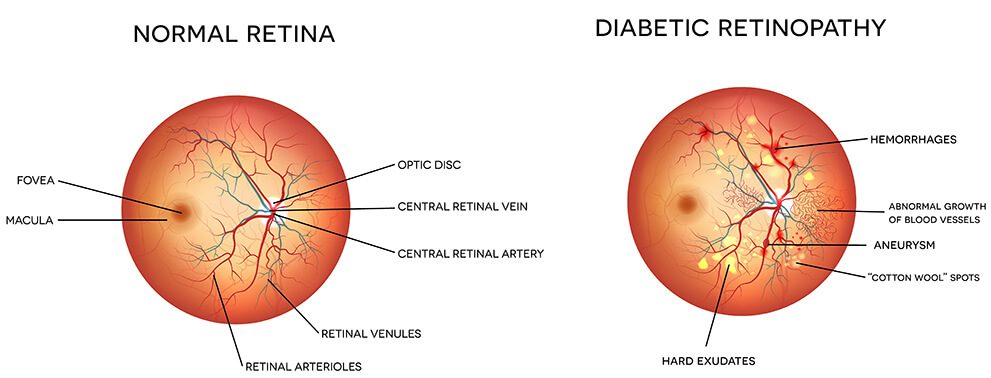
Diabetic retinopathy is the most common diabetic eye disease. It consists of damage to the blood vessels in the retina and can cause vision impairment or blindness.
Risk Factors
All people with diabetes are at risk, including Type I (juvenile onset) and Type II diabetes. During pregnancy, diabetic retinopathy may also be a problem for women with diabetes. All pregnant women with diabetes should have dilated eye examinations each trimester to protect their vision.
About 50 percent of people with diabetes will develop diabetic retinopathy during their lifetime.
Prevalence
About 50 percent of people with diabetes will develop diabetic retinopathy during their lifetime. The longer a person has diabetes, the higher the risk to develop diabetic retinopathy.
Vitreous floaters are sometimes seen as threadlike strands in the patient’s visual field. Typically these lines/spots float or drift as the eye moves
Symptoms
Floaters can be a sign of diabetic retinopathy. Sometimes difficulty reading or doing close work can indicate that fluid is collecting in the macula, the most light-sensitive part of the retina.
Treatment
Two treatment options are available; both of which are very effective but do not cure diabetic retinopathy: Laser surgery is performed in a doctor’s office or eye clinic. Before the surgery, your ophthalmologist will dilate your pupil and apply drops to numb the eye. In some cases, the doctor also may numb the area behind the eye to prevent any discomfort. A vitrectomy will be performed whenever laser surgery is deemed inefficient, usually if you have a lot of blood in the vitreous. A vitrectomy involves removing the cloudy vitreous and replacing it with a salt solution. Because the vitreous is mostly composed of water, you won’t notice the difference between the salt solution and the normal vitreous.



#FactFriday ☀️
With consistent sun exposure year-round, protecting your eyes is especially important. Wearing sunglasses with UV protection can help reduce long-term damage linked to cataract development and support overall eye health.
A simple step that makes a big difference 🕶️ ... See MoreSee Less
0 CommentsComment on Facebook
June is Cataract Awareness Month 👁️
Cataracts are a common age-related change that can lead to blurry vision, difficulty seeing at night, and faded colors. These changes often develop slowly but can begin to affect daily life over time.
The good news is that cataracts are treatable, and early attention can help support clearer, healthier vision. ... See MoreSee Less
0 CommentsComment on Facebook
There is no specific age for cataract surgery. Cataracts are most often related to aging, but they can develop earlier depending on a variety of factors including genetics, medical conditions, or previous eye injury.
Surgery is recommended when cataracts begin to interfere with daily life and vision starts affecting things like reading, driving especially at night, or overall clarity even with updated glasses.
If you are noticing changes in your vision, schedule with our team to learn more your treatment options. ... See MoreSee Less
0 CommentsComment on Facebook
This Memorial Day, we take a moment to honor and remember those who gave everything for our country. 🇺🇸
Grateful today and always for their sacrifice. ... See MoreSee Less
0 CommentsComment on Facebook
#FunFactFriday ... See MoreSee Less
0 CommentsComment on Facebook
A new treatment option for dry AMD is now available in Kona 🌺
This advancement gives patients access to care closer to home, offering new possibilities in managing dry age-related macular degeneration.
Talk with our team to learn more about whether this treatment may be right for you. ... See MoreSee Less
0 CommentsComment on Facebook