

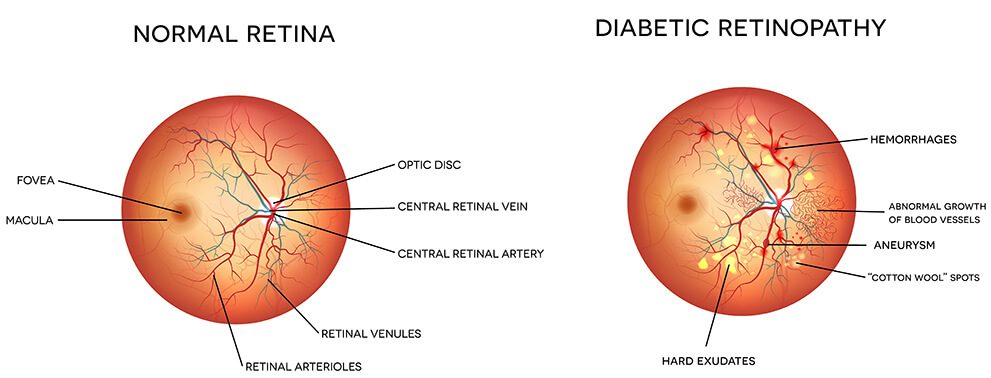
Diabetic retinopathy is the most common diabetic eye disease. It consists of damage to the blood vessels in the retina and can cause vision impairment or blindness.
Risk Factors
All people with diabetes are at risk, including Type I (juvenile onset) and Type II diabetes. During pregnancy, diabetic retinopathy may also be a problem for women with diabetes. All pregnant women with diabetes should have dilated eye examinations each trimester to protect their vision.
About 50 percent of people with diabetes will develop diabetic retinopathy during their lifetime.
Prevalence
About 50 percent of people with diabetes will develop diabetic retinopathy during their lifetime. The longer a person has diabetes, the higher the risk to develop diabetic retinopathy.
Vitreous floaters are sometimes seen as threadlike strands in the patient’s visual field. Typically these lines/spots float or drift as the eye moves
Symptoms
Floaters can be a sign of diabetic retinopathy. Sometimes difficulty reading or doing close work can indicate that fluid is collecting in the macula, the most light-sensitive part of the retina.
Treatment
Two treatment options are available; both of which are very effective but do not cure diabetic retinopathy: Laser surgery is performed in a doctor’s office or eye clinic. Before the surgery, your ophthalmologist will dilate your pupil and apply drops to numb the eye. In some cases, the doctor also may numb the area behind the eye to prevent any discomfort. A vitrectomy will be performed whenever laser surgery is deemed inefficient, usually if you have a lot of blood in the vitreous. A vitrectomy involves removing the cloudy vitreous and replacing it with a salt solution. Because the vitreous is mostly composed of water, you won’t notice the difference between the salt solution and the normal vitreous.



You blink about 14,000–19,000 times a day, spreading tears that protect, nourish, and keep your eyes comfortable. Blinking is one of your eyes’ most important defense systems.
But did you know, you may not be blinking right? You may not be fully closing your eyes, or blinking enough? It can be one of the causes of dry eye and one of the MANY things we check for in our comprehensive screening. It’s one of the reasons our dry eye team has so many happy and relieved patients!
#FridayFact ... See MoreSee Less
0 CommentsComment on Facebook
Cataract surgery has come a long way.
Laser-assisted cataract surgery allows for greater precision, customization, and the ability to correct astigmatism — helping patients achieve clearer, more predictable results.
Advanced technology. Personalized vision.
Schedule your cataract exam today! ... See MoreSee Less
0 CommentsComment on Facebook
🌺👁️Cataracts don’t just make vision blurry — they can make colors look dull and faded.
The natural lens of the eye becomes cloudy over time, muting the vibrant blues of the ocean, the greens of the mountains, and the bold colors all around our island.
Cataract surgery can restore clarity and bring those colors back to life.
Schedule your cataract exam with us today! ... See MoreSee Less
0 CommentsComment on Facebook
From urgent needs to cataract surgery, our centers across the islands are here to provide you with all the eye care services you need. Mahalo Lou for your kind words.
#TestimonialTuesday ... See MoreSee Less
0 CommentsComment on Facebook
With early diagnosis, monitoring, and today’s treatment options, many patients with AMD can continue to live active, independent lives.
February is a reminder that awareness, routine care, and early action matter. 👁️💙 ... See MoreSee Less
0 CommentsComment on Facebook
Lunar New Year is a time for fresh starts and bright possibilities. 🧧
As we welcome the new year, we’re honored to help our patients begin it with healthy vision and clear sight—today and all year long.
Happy Lunar New Year from our ʻohana to yours. ... See MoreSee Less
0 CommentsComment on Facebook