


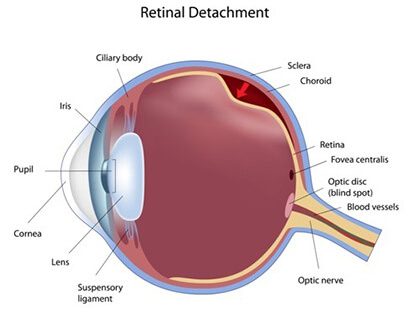
Condition
A retinal detachment occurs when the retina’s sensory and pigment layers separate. Because it can cause devastating damage to vision if left untreated, retinal detachment is considered an ocular emergency that requires immediate medical attention and surgery. Retinal tears commonly occur when there is traction on the retina by the vitreous gel inside the eye. In a child’s eye, the vitreous has an egg-white consistency and is firmly attached to certain areas of the retina. Over time, the vitreous gradually becomes thinner and more liquid and separates from the retina.
Risk Factors
The following are risk factors:
- age (40+)
- previous retinal detachments or tears
- extreme nearsightedness
- previous eye surgery or injury
Prevalence
1 in 15,000 of the general U.S. population.
Symptoms
Flashing lights, floating objects, and a gray curtain moving across the field of vision indicates a possible retinal detachment.
Treatment
Laser surgery or cryotherapy (freezing) is used to seal retinal tears and prevent detachment. If you suffer from retinal detachment, a surgical procedure called scleral buckling, in conjunction with cryotherapy or laser photocoagulation will be necessary.



#FactFriday ☀️
With consistent sun exposure year-round, protecting your eyes is especially important. Wearing sunglasses with UV protection can help reduce long-term damage linked to cataract development and support overall eye health.
A simple step that makes a big difference 🕶️ ... See MoreSee Less
0 CommentsComment on Facebook
June is Cataract Awareness Month 👁️
Cataracts are a common age-related change that can lead to blurry vision, difficulty seeing at night, and faded colors. These changes often develop slowly but can begin to affect daily life over time.
The good news is that cataracts are treatable, and early attention can help support clearer, healthier vision. ... See MoreSee Less
0 CommentsComment on Facebook
There is no specific age for cataract surgery. Cataracts are most often related to aging, but they can develop earlier depending on a variety of factors including genetics, medical conditions, or previous eye injury.
Surgery is recommended when cataracts begin to interfere with daily life and vision starts affecting things like reading, driving especially at night, or overall clarity even with updated glasses.
If you are noticing changes in your vision, schedule with our team to learn more your treatment options. ... See MoreSee Less
0 CommentsComment on Facebook
This Memorial Day, we take a moment to honor and remember those who gave everything for our country. 🇺🇸
Grateful today and always for their sacrifice. ... See MoreSee Less
0 CommentsComment on Facebook
#FunFactFriday ... See MoreSee Less
0 CommentsComment on Facebook
A new treatment option for dry AMD is now available in Kona 🌺
This advancement gives patients access to care closer to home, offering new possibilities in managing dry age-related macular degeneration.
Talk with our team to learn more about whether this treatment may be right for you. ... See MoreSee Less
0 CommentsComment on Facebook